AI visibility · · AIA Matrix
ChatGPT, Gemini, Claude, Perplexity: Make Them All Recommend You
When a customer asks an AI assistant which business to choose, does your name come up—or does the conversation go straight to your competitors?
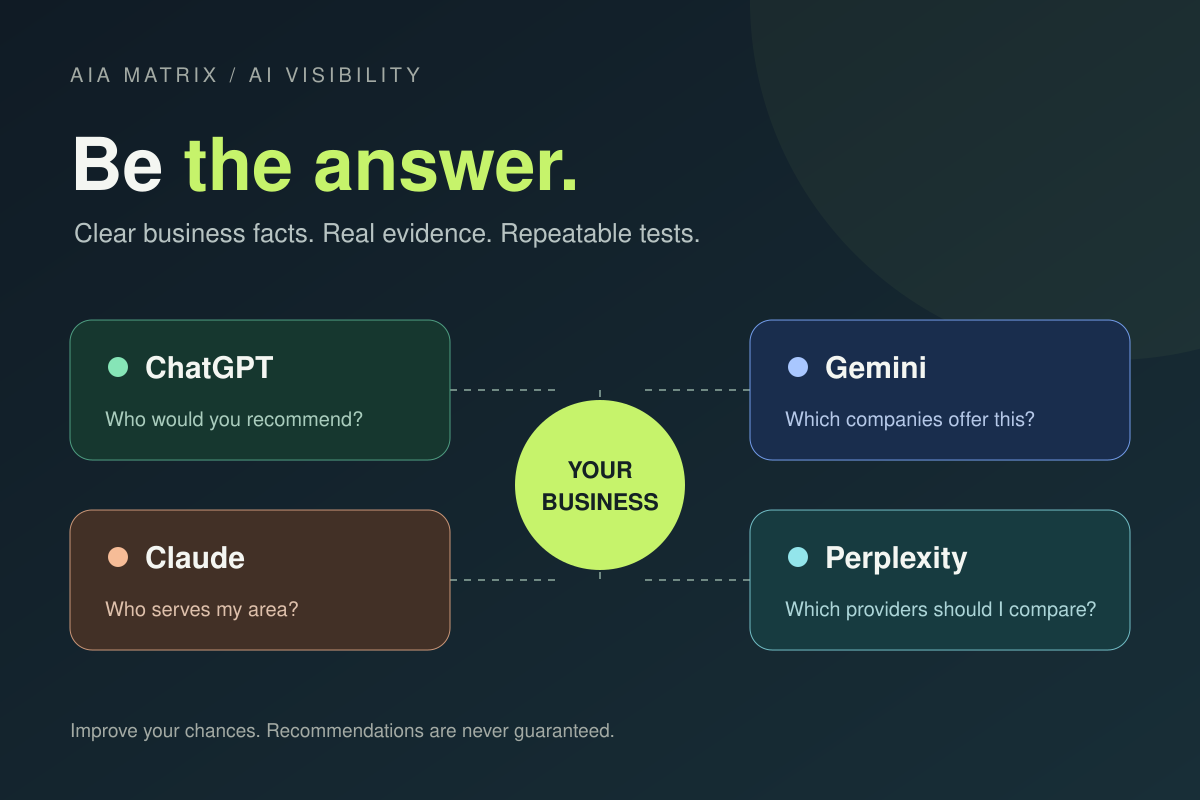
A customer might ask, “Which companies offer reliable car service from LAX?” or “Who buys gold jewelry in Marin County?” They want a shortlist of businesses they can contact. Being included in that shortlist is the goal.
You cannot make every AI assistant recommend you. You can improve the information available about your business, remove barriers to reading it, and test whether your name appears for relevant questions. That gives you a practical way to work toward the headline’s ambition.
Start with the question your customer would ask
Asking “Is my business good?” tests what an assistant says after you introduce the name. It does not show whether a new customer would discover you.
For discovery, leave your brand out. Include your real service and location, and ask for named companies. A useful set might include:
- “Recommend three private car services for an early-morning pickup at LAX.”
- “Which companies offer affordable airport transfers from Los Angeles to Anaheim?”
- “Who offers a private van service from LAX for a family with luggage?”
- “Which Los Angeles car services should I compare for a reliable airport pickup?”
These are examples, not claims about any particular business. Adapt them to services and places you actually cover. Save the wording so you can repeat the same test later.
Understand what the four assistants can show
Do not assume that four assistants will produce the same shortlist, use the same sources, or search the web on every request. Their available tools and the context of a conversation matter.
| Assistant | What to check |
|---|---|
| ChatGPT | OpenAI documents OAI-SearchBot as its search crawler. Review access separately from GPTBot, which serves a different purpose. Crawler guidance |
| Gemini | When Gemini supplies source links, inspect them. Google says some Gemini responses have no sources or related links. Gemini source guidance |
| Claude | For a current-information test, use web search where available and inspect citations. Claude documents web search as a way to ground answers in live web content. Web search guidance |
| Perplexity | Perplexity recommends allowing PerplexityBot and its published IP ranges for search visibility. Its user-request fetcher is a separate agent. Crawler guidance |
Google’s AI Overviews and AI Mode are also distinct from the Gemini app. Google’s Search guidance says established SEO practices remain relevant and no special optimization is required for those Search features. Treat that as guidance for Google Search, not a promise about every assistant.
Give your business a clear, consistent identity
Read your homepage as if you have never heard of the company. Can you identify its name, main services, location, service area and next step without guessing?
Put those details in ordinary page text. Give each core service a useful page. Explain where it is available, who it suits, what is included, and how to request a quote or book. If your prices depend on the job, describe the factors instead of inventing a starting price.
Check the same facts on your contact page, business profiles and relevant directories. Correct old addresses, discontinued services and inconsistent phone numbers. For several locations, make it clear which services belong to each one.
Replace broad claims with evidence customers can check
“The best service in town” gives a customer little to evaluate. Specific information helps them compare their options: booking terms, documented qualifications, genuine customer reviews, real project examples and a clear explanation of how the service works.
Publish evidence you can substantiate. Link to the relevant source when you mention an award, membership or certification. Keep testimonials accurate and ask customers for honest feedback. These are useful improvements to your public information, not a known formula for an AI ranking score.
Look at the sources behind competing recommendations, too. If an answer cites a local directory, review whether your own listing is accurate and relevant. If it cites a competitor’s service page, compare how clearly that page answers the customer’s need. Use this to find information gaps rather than copy another business’s claims.
Check whether your pages can actually be read
A detailed page cannot help a retrieval system if it encounters a login screen, an error page or a security challenge instead. Ask your webmaster to check important public URLs, crawler rules and server logs. Keep essential service details accessible as text rather than only inside images.
Review access for the crawlers you intend to allow, using each provider’s documentation. Verify legitimate requests before changing firewall rules. Keep private areas protected; opening the entire site is not necessary.
Use descriptive headings and links so a reader can follow the page. Structured data should match visible facts. An llms.txt file can offer an additional content index, but it is not a universal submission channel or a guarantee that these four assistants will read or recommend you.
Measure recommendations, not just appearances
Keep three outcomes separate:
- Mention: the answer names your business.
- Recommendation: it positively suggests your business as an option.
- Citation: it links to a source, which may or may not be your website.
For example, “I cannot verify this business” is a mention, but it is not a recommendation. A source link alone does not establish that the assistant chose your company.
Record the question, provider, date, answer and suggested companies. Note any incorrect services, locations or prices, and check them against current facts. Repeat the same questions under similar conditions after meaningful updates. A handful of answers is a sample, not your share of all AI conversations.
Use AIA Matrix to connect the audit with the answer
The website audit and AI Mention Check answer different questions. The audit reviews your site’s structure, evidence and accessibility and provides recommendations and downloadable implementation files. The AIA Score is an audit measure, not a predicted recommendation rate.
AI Mention Check lives on the dashboard. Select a website scan, generate the questions available in your package, and compare the returned answers and company recommendations across OpenAI, Google Gemini, Anthropic Claude and Perplexity.
These checks use provider APIs. They are controlled tests, not recordings of what every customer sees in the consumer apps. Models, search behavior, user context and timing can change the results. Use them to identify gaps and track a consistent test, rather than claim a guaranteed ranking.
A practical plan for this week
- Choose your questions. Start with the services and locations that matter most to your business.
- Save a baseline. Record each assistant’s answers, recommended companies and available sources.
- Fix the clearest gaps. Correct inaccessible pages, missing service details and conflicting business information.
- Repeat and compare. Keep the questions stable and allow time for public information to be rediscovered. There is no universal update deadline.
Common questions
Can I guarantee that all four will recommend my business?
No. You control your website and the accuracy of information you publish. You do not control an assistant’s answer, its available sources or the customer’s context.
Does a higher AIA Score mean more AI recommendations?
Not necessarily. A clearer website and a recommendation are different outcomes. Review the audit findings and the actual answers separately.
Should I stop doing SEO?
No. Keep your site useful, discoverable and accurate. Google explicitly says SEO practices remain relevant to its AI Search features. Testing AI recommendations adds another way to evaluate visibility.
Provider guidance checked October 23, 2026. The linked official documentation may change. Examples are illustrative; no customer results or performance gains are implied.